
A freelance contract records who is doing the work, what will be delivered, how and when payment is made, and what happens if the project changes or ends. Marketplace terms can already cover some of those points when the job stays on a platform. This checklist is for a written agreement with a direct client, where those platform terms do not apply.
The clause list below is common practice, drawn from Upwork's resources article on writing a freelance contract, opened on 11 November 2026 (visible published line 20 August 2026). That page presents the items as starting points, not as a required legal form, and states that the material is not legal advice. Short wording in this article is illustrative only. It is not a template to copy into a signed document. Rules differ by country, and a local lawyer should review anything beyond a simple project.
Parties, scope and deliverables
Name both parties and include a contact method that will be used for notices. Then describe the work in enough detail that a later argument about "what was included" can be checked against the page.
Scope you can sign is useful preparation even when the final document is a contract rather than a proposal: list the deliverables, the formats, and what is out of scope. Scoping a one-off job covers the same need when the work is a short, self-contained task. If the client expects a specific tool, a number of pages or assets, or a limit on the use of AI or subcontractors, write that limit in. The Upwork resources page, opened 11 November 2026, includes expectations about tools and AI use among the starting points for a scope section.
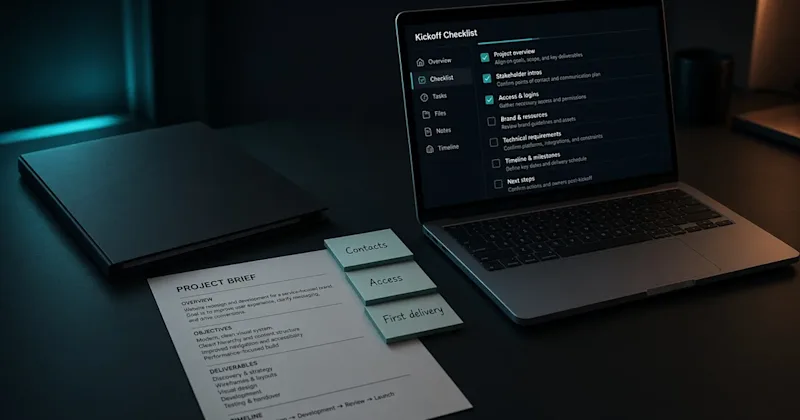
Timeline and what the client must provide
A delivery date is only useful if the inputs that date depends on are also written down: feedback windows, access, brand files, or subject-matter reviews. If the schedule slips because those items arrive late, the contract can say that dates move by the same delay, or that a new date will be agreed in writing. Do not invent a standard notice period. Write the one both sides can keep.
Fees, deposit and payment schedule
State the fee, the currency, what it covers, and when each payment is due. A deposit before work starts, a payment mid-project, or payment on delivery are all options; none of them is presented here as a required split. If a late fee will apply, write the amount or the method and the conditions in the agreement before work begins. Upwork's resources page asks whether a late fee applies and at what amount. This article does not invent a percentage or a standard due-date label.
Revisions and change requests
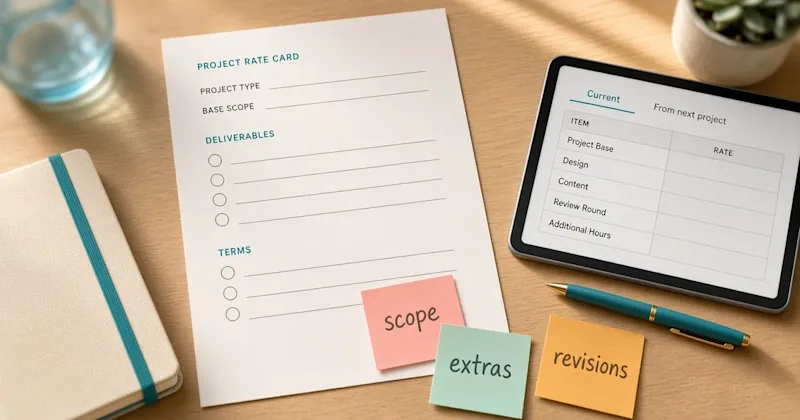
Define what a revision "round" means: a set of comments on a named draft, for example, rather than an open-ended right to request changes. Then say how many rounds are included in the fee, and how extra rounds or out-of-scope changes will be priced. There is no standard number of rounds. The useful test is whether both sides can point to the same definition if the work starts to expand.
Acceptance: when a deliverable counts as approved
Write how the client accepts work: written approval, or a stated number of days after delivery if no comments arrive. If silence will count as acceptance, say so plainly, and say how comments must be sent. This avoids a project that is "almost done" for weeks without a recorded decision.
Cancellation and kill fee
A kill fee is the amount the parties agree will still be paid if the client ends the project before the agreed work is complete. It can cover work already done, or time that was reserved and cannot be rebooked. There is no standard percentage, and a kill fee is not automatic. If one will apply, write the amount or the method, when it is payable, and what happens to work already delivered.
The same section can say how either side may cancel, how much notice is required, and whether already-approved work remains payable. Those terms are negotiated. They should be read before work starts, not after a cancellation email arrives.
Ownership and confidentiality
Say when ownership of the work passes, what the client may do with it, and what the freelancer may show in a portfolio. Ownership and copyright rules differ by country. This article does not state work-for-hire, or any other single transfer rule, as a universal standard. For specialized writing, ghostwriting contract terms discusses credit and ownership in that field; those points still need wording that fits the job and the applicable law.
If confidential information will be shared, write what must be kept confidential, for how long, and what is excluded, such as information that is already public. A separate non-disclosure agreement is sometimes used; whether one is needed is a matter for the parties and, where the information is sensitive, for local advice.
Termination, disputes and governing law
A termination clause explains how the agreement can end for reasons other than a completed delivery: a material breach, a long pause, or a convenience exit, if the parties want one. A disputes clause can say that the parties will try to resolve a disagreement in writing before taking further steps.
Naming a governing law and a place for disputes is common practice because it reduces later argument about which rules apply. The "right" jurisdiction is not a general rule in this article. It depends on where the parties are, and it is a point for local advice, especially when the parties are in different countries.
Before sending
Before the document goes to the client, check that:
Both parties are named, and a contact method is included.
Scope, exclusions, and the client's inputs are written down.
The fee, currency, due dates, and any deposit are clear.
Revisions, acceptance, cancellation, and any kill fee are defined.
Ownership, confidentiality, termination, and governing law have been read, not left as leftovers.
If the client wants to change a clause, treat the change as a negotiation: record what will replace the original wording, and do not start the work until both sides have agreed the new version. Unusual limits on other clients, broad indemnity, or ownership terms that transfer rights before payment is a reason to pause and, for anything beyond a simple project, to ask a local lawyer.
This article is general information, not legal advice. A local lawyer should review a contract that is more than a simple project, or that involves parties in more than one country.