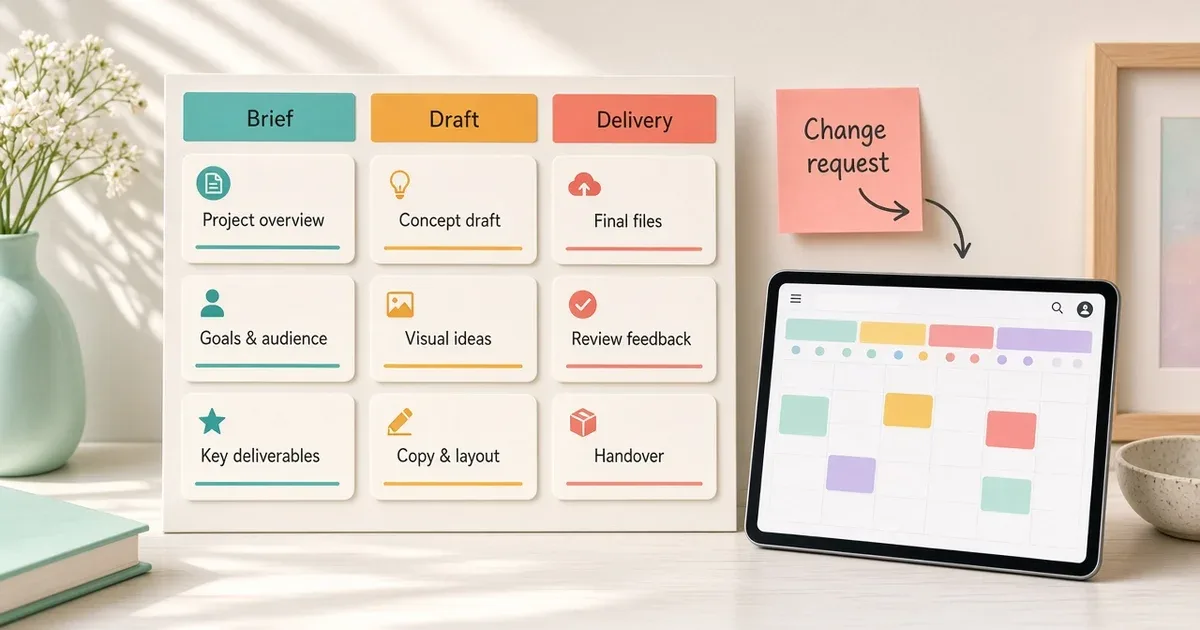
Freelance scope creep is extra work that was not part of the agreed scope: a new page, another feature, more items, or more rounds of changes than the agreement allowed. The fix is a short written change request that names the added work, its price and its effect on the timeline, then waits for approval. It is not doing the extras for free, and it is not rewriting the whole contract every time something new comes up.
This guide is for freelancers already in the middle of a project when the work starts to expand. It covers how to recognise the change, how to describe it, and how to price it.
What counts as extra work, and what is a revision
The line between a revision and new work comes from what was agreed, not from how big the request feels.
A revision changes something that was already in scope, within the number of rounds the agreement allows. Adjusting colours on an agreed design, or tightening an agreed article, is a revision.
Extra work adds something that was not in scope: a deliverable, a feature, more volume, a new channel, or rounds beyond the agreed limit. Adding a blog section to an agreed five-page site, or turning one article into a series, is extra work.
Beginners often meet this first on small jobs. The guide to extra work requests on one-off projects treats an added request as a new task or a written scope change, and the same principle holds on larger projects. Proposal-stage boundaries help too: the scope in the proposal template already treats extra pages as a separate milestone.
When the agreement includes a revision clause, check it before replying. It decides whether the request is covered.
Pause and describe the new work before doing it
When a request looks out of scope, the useful first step is to stop and describe it, not to start and invoice later.
Acknowledge the request. Thank the client and confirm what they are asking for in your own words.
Compare it with the agreed scope. Note which part is new and which part, if any, is already covered.
Ask the questions you need for an estimate. Volume, format, deadline, and who approves it.
Say that you will send a short change request with the price and timing before starting.
This keeps the conversation calm. The client hears that the request is welcome and will be handled properly, and nothing is done on the assumption that it is free.
Write the change request
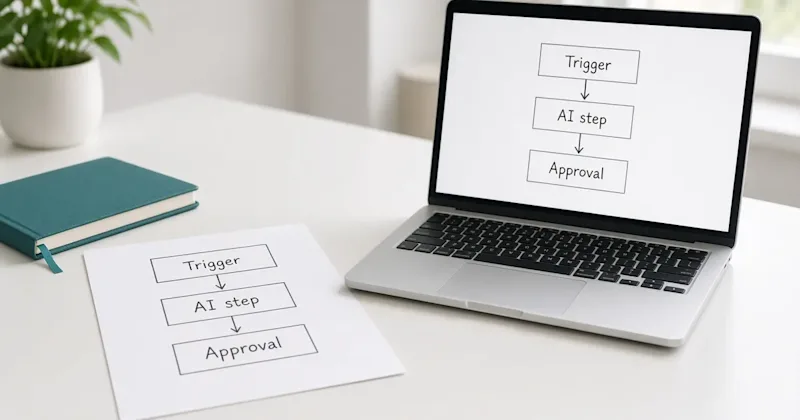
A change request is a short document or message, not a new contract. It should cover:
What is being added. Describe the new work specifically enough that both sides would recognise it as done.
What is not changing. State that the rest of the agreed scope, price and terms stay the same.
The extra fee. A fixed price for the added work, or an hourly estimate with a cap.
The effect on timing. Whether the final delivery date moves, and by how much.
When the new work starts. Usually once the client approves in writing and, if agreed, pays any deposit for the change.
Example change request (illustrative):
Subject: Change request: [added item] for [project]
Hi [Name],
Thanks for the note about [added item]. This is outside the current scope, which covers [agreed scope in one line].
Added work: [description].
Price for this addition: [amount], invoiced [timing].
Timeline: the final delivery moves from [date] to [date] / no change.
Everything else in our agreement stays the same.
If you would like to go ahead, reply to approve and I will start on [date]. If you prefer to keep the original scope, I will continue as planned.
The last line matters. It gives the client a clear choice without pressure, and either answer keeps the project moving.
How to price the extra work
There is no standard markup for added work, and no fixed percentage that suits every job. A simple method works for most cases:
Estimate the added effort. Count the hours, or the extra deliverables, the change will take, including review and revisions on the new part.
Apply your current rate. Use the same rate or unit price as the original work, unless the new work is a different kind of task with its own rate.
Account for disruption. If the change forces rework of finished parts, include that time.
Quote a fixed amount or a capped estimate. A fixed price is easier for the client to approve; a cap protects both sides on uncertain work.
For website projects, the guide on how to price added work such as copywriting or a shop is a useful reference for typical add-ons.
If the client wants the extra work inside the original fee
Some clients will ask for the addition at no extra cost. There are a few honest ways to respond:
Decline the addition and continue with the agreed scope.
Swap scope. Add the new item and remove something of similar size that has not been started.
Move it later. Deliver the agreed scope first, then quote the addition as a separate follow-on job.
Include it once, on purpose. If you choose to absorb a small extra for a valued client, say so in writing and make clear it is a one-off, so it does not become the new baseline.
No wording guarantees agreement. The aim is that every option is clear and written down.
After approval
Once the client approves, update the written record: attach the approved change request to the agreement, adjust the milestone or delivery date, and add the extra fee to the next invoice as a separate line. Keeping each change as its own line makes the final invoice easy to check.
On marketplaces, the change should go through the platform rather than a side agreement:
On Upwork fixed-price contracts, Upwork Help (opened 12 November 2026) says freelancers can send requests to add, edit or delete future milestones, and the client accepts or rejects them.
On Fiverr, the freelancer guide to the order process (opened 12 November 2026) says sellers can adjust an order, such as adding Gig Extras, or request a new delivery date.
If payment for approved extra work later becomes the problem, that is a separate issue from scope, handled through the invoice and payment follow-up process.
The next time a request feels bigger than the brief, pause, describe it, and send the change request before starting.