Freelance burnout is often discussed as a feeling, but the parts a freelancer can control are practical: how many hours are worked, how much work is accepted, and how clients can reach you. Because a freelancer decides what to say yes to, work can pile up quickly without anyone else noticing. This article covers workload and boundary habits that can make freelance work more sustainable. It is not medical advice, and it does not diagnose or treat burnout or any health condition.
Freelancing has trade-offs that make this harder: uneven income, quiet solo work, and hours that blur into evenings. Those are covered as part of the bigger picture in the post on hours and boundaries. This article focuses on the habits that protect a working day.
Signs the workload is too heavy
These are work patterns, not a medical checklist. They suggest the schedule needs attention:
No full days off in recent weeks.
Replying to client messages late at night as a normal habit, not an exception.
Accepting every request, including ones outside your usual service.
No set end to the working day.
Delivery dates regularly slipping, or work being finished in a rush the night before.
Starting new projects before current ones are delivered.
One or two of these during a busy week is common. When several become the default, it is a sign to change how work is planned and accepted.
Set hours and a finish point for the working day
Freelancers do not need to copy office hours, but they benefit from deciding hours in advance rather than working until the inbox is empty.
Choose working hours that fit your clients' time zones and your own life, and write them down.
Set a finish point. A fixed time, or a defined last task, after which client work stops.
Plan the next day before stopping. A short list of tomorrow's priorities makes it easier to stop without worrying about forgetting something.
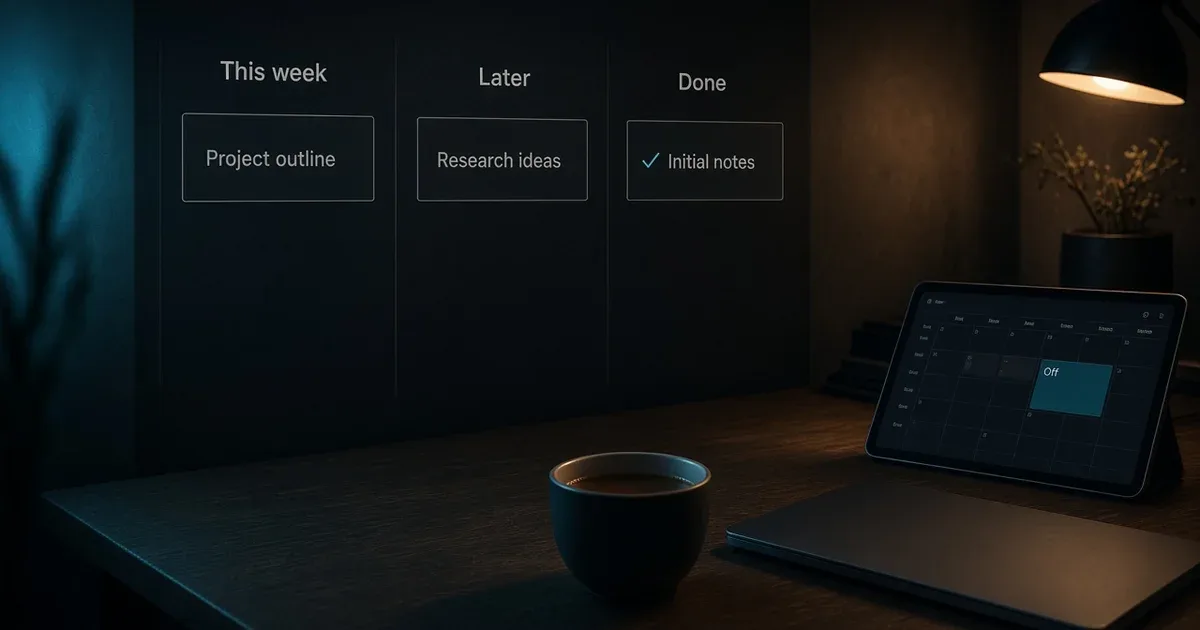
Protect at least one regular day off and treat it like a booked commitment.
The beginners guide includes hard weeks advice on working hours and uneven periods, which pairs well with this habit.
Limit how much new work is accepted
Overwork usually starts at the moment of saying yes. A short capacity check before accepting a new project helps:
List current commitments with their delivery dates.
Estimate the hours the new work needs, including revisions and communication.
Check the calendar for those hours inside your set working time, not in evenings or days off.
Decide: accept, accept with a later start date, or decline.
If the calendar fits, accept with confidence. If it only fits by giving up rest, the answer is a later start or a no. Some freelancers also review their rates when demand is consistently higher than their available time, since fewer, better-paid projects can mean less overload.
Say no, or offer a later start date
Declining work can feel risky, especially for newer freelancers. A clear, polite reply protects both the client and the quality of your existing commitments.
Declining (illustrative):
Thank you for thinking of me for [project]. My schedule is full for the next few weeks, so I cannot take this on and do it well. I hope it goes smoothly, and I would be glad to hear from you on future work.
Offering a later start (illustrative):
Thanks for the details on [project]. My current schedule is booked until [date]. I could start on [date] and deliver by [date]. If that timing works, I can send a short scope and quote.
A later start date is often acceptable to clients who are planning ahead, and it keeps the conversation open without overloading the current week.
Protect communication boundaries
Constant availability is one of the main ways freelance work spreads across the day. Boundaries work best when they are stated at the start of a project:
Name one main channel for project communication, such as email or a single shared chat.
State a response window, for example replies within one working day, and your usual hours.
Turn off work notifications outside working hours, or use scheduled quiet times on your phone.
Batch replies at set points in the day instead of answering each message as it arrives.
Define what counts as urgent with each client, and how they should reach you if it happens.
Clients generally adapt to a predictable pattern. Replies that arrive at any hour teach the opposite expectation.
Plan for uneven weeks
Freelance work rarely arrives evenly. Some habits reduce the pressure of busy and quiet periods:
Leave buffer time in the schedule for revisions, delays and admin.
Space delivery dates so several projects do not finish on the same day.
Use quiet periods deliberately for admin, portfolio updates, learning or rest, so they are not spent only worrying about the next job.
Keep a simple record of hours worked each week. It shows when the workload is creeping up before it becomes a problem.
Review the week, not just the day
A short weekly review helps spot problems early. At the end of each week, look at three things: the hours actually worked compared with the hours planned, any deadlines that slipped, and any work accepted that did not fit the capacity check. If the same pattern shows up several weeks in a row, adjust one thing at a time, such as an earlier finish point, a longer default delivery time, or fewer new projects per month. Small, repeated adjustments are easier to keep than a complete change of routine.
If work is affecting your health
If work pressure is affecting your sleep, health or daily life, speak with a qualified professional. The habits in this article are about managing a schedule; they are not a substitute for professional help.
A useful first step this week is to write down your working hours and response window, then apply the capacity check to the next request that arrives.