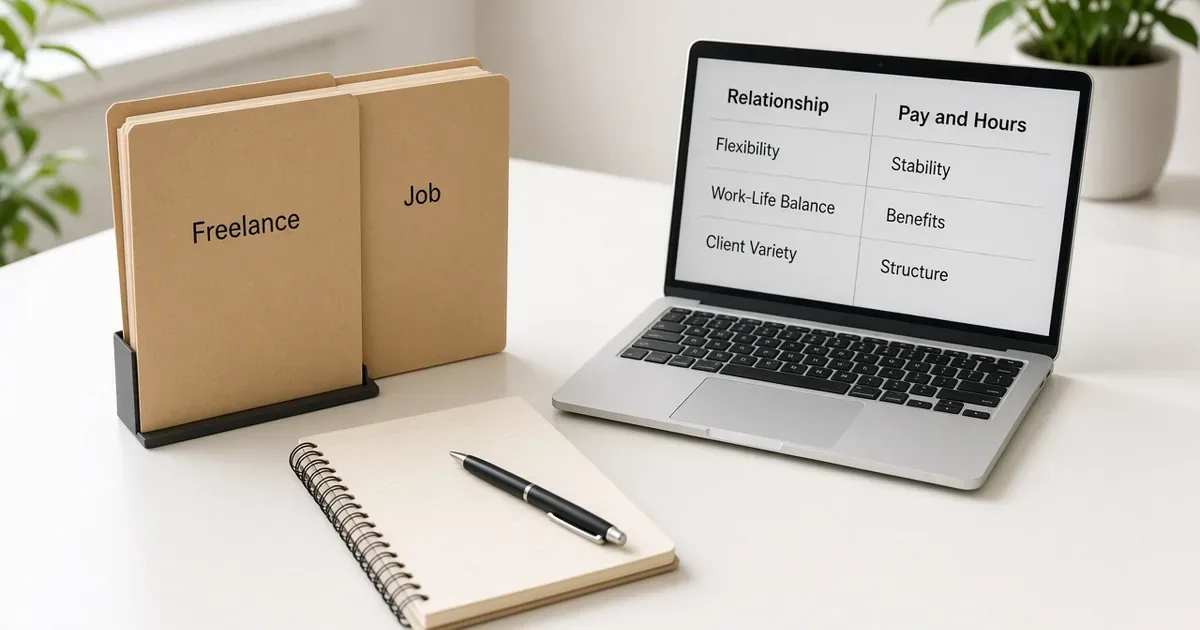
"Remote" describes where the work happens. "Freelance" and "employee" describe the relationship. A remote job can still be employment for one organisation. Freelancing is work sold to clients. Neither is automatically better.
The existing guide to freelance life tradeoffs already weighs freelance life on its own. This article is the comparison with a remote employee job: who the work is for, how pay arrives, who covers time off, and how to choose, or combine, the two when the contract allows it.
The real difference
In a remote job, there is usually one employer, a role, and a schedule the organisation sets. Pay, tools, and leave (if any) come through that relationship. The work may happen at home, in another city, or in another country. The location does not, by itself, make the person a freelancer.
In freelance work, the client buys a result or a block of time. There may be several clients at once, or none for a stretch. The freelancer finds the work, agrees the scope, delivers it, and invoices for it. Tools, time off, and paperwork sit with the freelancer unless a contract says otherwise.
A remote freelance client and a remote employer can look similar on a video call. The difference shows up in the agreement: who can end the work, who sets the hours, who provides the laptop, and who is responsible if a delivery is late. If those terms are unclear, the label on the job post is not enough. Get them in writing before the work starts.
Rules differ by country, and sometimes by the wording of a single contract. This post stays general. It is not legal or tax advice, and it does not name a form, a tax rate, or a "set aside X percent" rule.
Income and risk
A job usually pays on a set schedule while it lasts. That predictability is real, and so is the risk that the role can end. Freelance income depends on finding and finishing work. It can be higher in a busy month and lower in a quiet one. This article will not invent salary bands or a "typical" freelance income, and it will not tell anyone to keep a set number of months of savings.
The freelance life tradeoffs post already covers the uneven side of freelance income in more detail. The useful comparison here is simply this: one path prices a role, the other prices a project or a period of availability. Neither path erases risk; they place it in different spots.
Control, hours and benefits
Freelancers often choose clients and projects, and they also fund their own time off and cover. That control is limited by whatever work is actually available, and by the deadlines already agreed. Employees often have less say over the work, and may receive paid leave, sick pay, or other benefits, depending on the contract and the country. A remote employee job can still have core hours, meetings, and tools chosen by the employer.
None of this is a score. A person who wants a predictable payment this month may prefer a job. A person who already has a sample and a way to find a first client may prefer freelance work. Many people want some of both. That is only possible if the employment contract and local rules allow outside work.
Hours can look flexible on both paths and still be demanding. A remote job can fill the calendar with meetings. Freelance work can fill it with proposals, revisions, and unpaid admin. Control over the work is not the same as a lighter week. The better question is which kind of uncertainty is acceptable: a manager's priorities, or a quieter pipeline.
Paperwork and legal status
Employees and contractors are treated differently in different countries. The same person can be an employee in one arrangement and a freelancer in another, in the same year, if the rules allow it. Official guidance where the person lives is the place to check status, tax, and registration. This article will not borrow a tax rate from another blog, and it will not invent a form number.
If a contract already exists, read it before taking outside work. Some employment agreements limit other paid work, use of the employer's tools, or work for a competitor. That is a contract question, not a productivity tip.
How to choose, or how to combine both
A few questions are more useful than a slogan.
Does this month need a predictable payment? Is there already a sample, and a way to find a first client? Does an existing employment contract limit outside work? Is there time to do both well, or would one of them suffer?
A combination is possible only if the employment contract and local rules allow it. There is no official "switch when side income reaches X" line. Everyday freelance habits help on the freelance side of a mixed path. For a student or first-job reader, fitting work around school already covers age, classes, and time. If freelance work is already the chosen path, which platform fits you is the next marketplace question, not a second employment decision.
2026 note
AI and remote hiring are both in motion. Official research can describe that movement without turning this post into a labour-market forecast. Upwork's Future Workforce Index 2026, based on a survey of 2,400 U.S.-based workers conducted from March to April 2026 and opened on 13 November 2026, reported that skilled freelancing rose from 28% of skilled knowledge workers in 2025 to 38% in 2026, and that 58% of full-time employees said they were considering freelancing, up from 36% the year before. Those are U.S. survey figures, not a global pay comparison, and they do not say freelance work is "better." They also do not replace a read of the actual contract in front of the reader. This post still helps someone choose a path, not forecast the labour market.